Maine families are all too often navigating persistent challenges in accessing the housing that is foundational to their success and well-being. Across the state, numerous factors have led to steep increases in housing costs, fewer options, and increasing barriers to home ownership. The rising pressures have created uncertainty and stressful situations for many families, who have had to divert resources from other critical areas of needs or even experience the loss of housing.
In this Data Snapshot, we take a look at housing issues affecting Maine families and some of the ways the John T. Gorman Foundation is contributing to efforts aimed at creating greater housing stability.
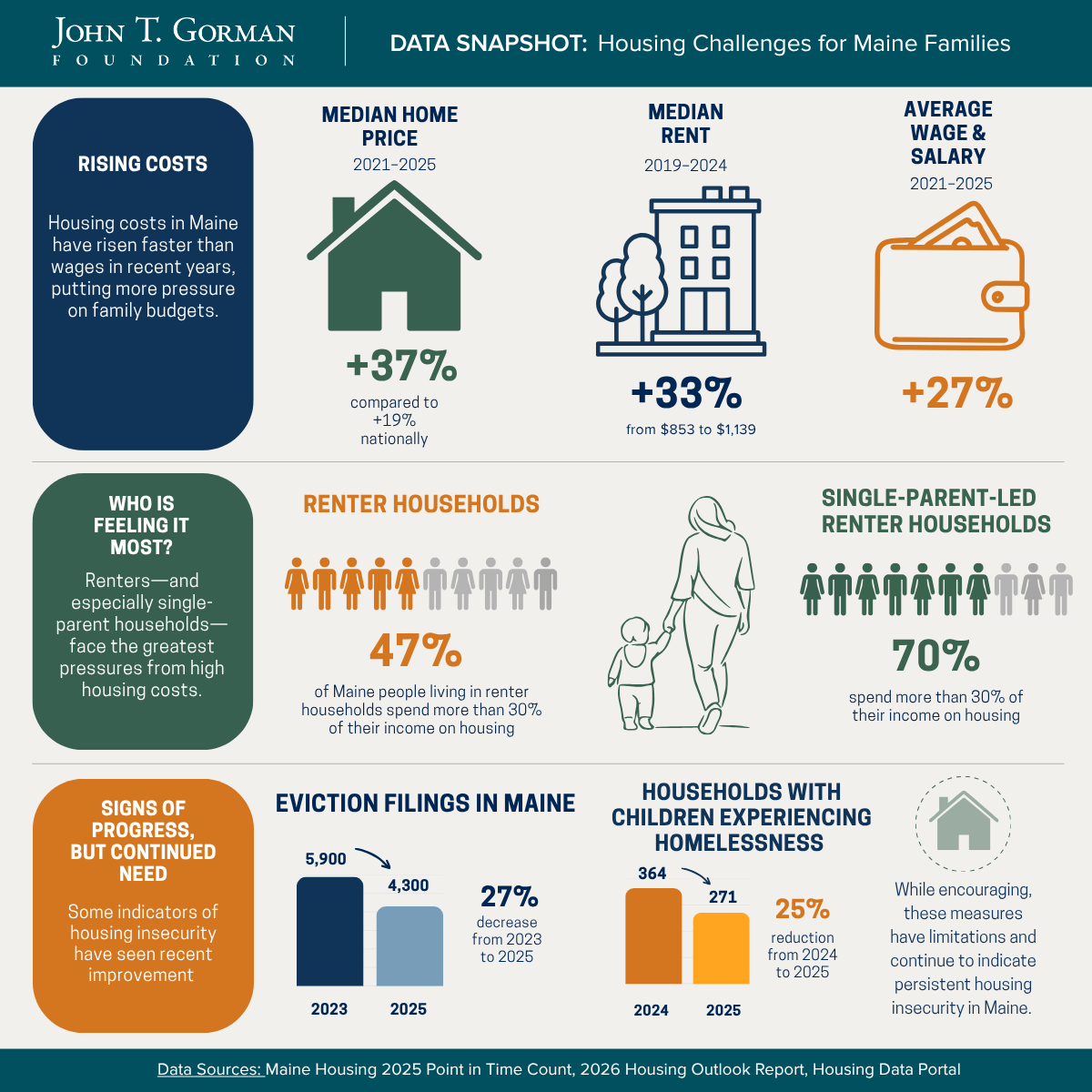
The costs of housing – whether renting or homeownership – have risen sharply in recent years and far outpace increases in earnings.
- From 2021-2025, the median home price in Maine increased by 37%, compared to 19% nationally. The median home price in 10 of 16 Maine counties now exceeds $250,000, making it increasingly difficult for first-time homebuyers to enter the market.
- From 2019-2024, the median rent in Maine rose 33% – from $853 to $1,139.
- Rising home costs and rents have both outpaced the average Maine wage and salary increase of 27% from 2021-2025.
Certain families – including renters and single-parent households – are facing especially great pressures with housing costs.
- 47% of Maine people living in renter households face a high housing cost burden (more than 30% of their income) – more than twice the rate of homeowners.
- 70% of single-parent-led renter households had a high housing cost burden, the highest among all groups of renters.
Amid these challenges, a few indicators of housing insecurity have seen recent decreases
- After peaking at nearly 6,000 in 2023, eviction filings in Maine have declined over the last two years to 4,300 in 2025.
- The most recent point-in-time count (2025) reported a 25% reduction in the number of households with children experiencing homelessness from the previous year – from 364 to 271.
- While these numbers are encouraging, it’s important to recognize the limitations of these measures and acknowledge the continued persistence of housing insecurity in Maine.
From Statistics to Strategies
Because housing is such a critical part of child and family well-being, the John T. Gorman Foundation has invested in a range of strategies to assist families in a challenging housing environment while contributing to partnerships that are preserving or expanding affordable housing.
These efforts include supporting Pine Tree Legal Assistance’s work with families facing eviction, supporting community partnerships in Sanford Schools to prevent homelessness among students and their families, continued work at Bangor Housing to support families on the path to home ownership, and a recent program-related investment to help residents purchase the Cedar Falls Mobile Home Park, preserving 129 units of affordable housing while creating the opportunity to develop 82 more.
As Maine continues to address this important issue, the Foundation is fortunate to work with such dedicated partners to help families meet their housing needs during this challenging time and support longer-term solutions.
Data Sources