A two-day summit connected promising approaches from Maine and across the country with opportunities for action
While the John T. Gorman Foundation develops and tests promising strategies to help Maine children and families thrive, it also brings together leaders to learn about new approaches and from each other.
On August 12 and 13, the Foundation partnered with Ascend at the Aspen Institute to host a two-day summit focused on solutions in the critical areas of housing and justice. Nearly 70 participants from Maine and around the country – representing nonprofits, public agencies, local and national funders – gathered to discuss promising strategies and what it would take to move them forward. The event was one of several conversations Ascend has held nationally to advance Forward with Families, an initiative to amplify ideas and strategies that are creating greater well-being for families across the country.
Photos and details of these two impactful days below.
Day 1: Housing




Stable housing is fundamental to child and family well-being, yet rising costs and limited availability make it difficult for many Maine families to find and afford a home. The convening’s first day focused on how public-private partnerships can preserve affordable housing options and support new opportunities for development.
A panel explored two interconnected partnerships that show what becomes possible when organizations coordinate their strategies and combine resources.
Moving Families Forward – led by Bangor Housing with the Boys & Girls Club of Bangor – helps families in public housing pursue education and career goals, strengthen their finances, and build savings. Panelist Jessy Sherwood knows the program from both sides: she is a Bangor Housing resident and on staff as a Family Self-Sufficiency Achievement Coach. As a single mother of two sons, Moving Families Forward supported her in earning a college degree and working toward homeownership.
“I knew that I wanted to be the first for my children – the first to go to college, the first to own a home,” she said.
But Bangor Housing CEO Mike Myatt said that even when families reach their savings goals, Maine’s housing shortage can make it difficult to find an affordable home to purchase. The rate of families leaving Bangor Housing has slowed, he said, and a growing number are waiting for their services.
A developing partnership nearby has provided a key solution.
When an outside investor sought to purchase the Cedar Falls Mobile Home Park – just across the street from Bangor Housing’s Capehart neighborhood – a new state law gave residents an opportunity to buy it themselves. With a grant and Program Related Investment, the Foundation joined Genesis Community Loan Fund, Cooperative Development Institute, MaineHousing, Bangor Savings and other partners to provide affordable financing for the resident cooperative. The purchase preserved 129 homes and created the potential for dozens more. Bangor Housing is now working to develop vacant lots with manufactured homes, creating a possible path to homeownership for Moving Families Forward graduates.
Convening attendees considered what made these collaborations work and where similar approaches could address other housing challenges.
Day 2: Justice


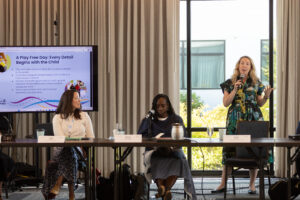
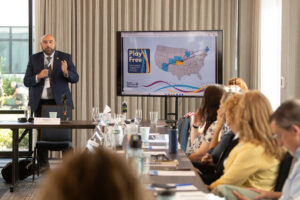
Parental incarceration can abruptly separate families – isolating children from a parent, changing where and with whom they live, and placing new responsibilities on caregivers. The second day of the summit focused on preserving safe, healthy family connections during this challenging experience.
Ebony Underwood, founder and CEO of WE GOT US NOW, grounded the day’s discussion in her experience growing up while her father was incarcerated — and in her organization’s national work to support the well-being of children affected by incarceration.
“Children do not experience parental incarceration as a corrections issue,” Underwood said. “They experience it at home, at school, in the doctor’s office, in the decisions their caregivers are forced to make, and whether they can speak to or visit their incarcerated parent.”
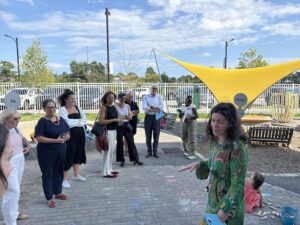
That whole-family perspective has been adopted by Play Free, an initiative created by the Kansas Children’s Discovery Center in partnership with the Kansas Department of Corrections. Dené Mosier, the museum’s president and CEO, described how the program transforms family visits into child-led time for play, meals, photographs, and everyday parenting – at the museum, through a mobile museum, and in redesigned spaces within correctional facilities.
“Children don’t stop needing hugs when their parent is incarcerated,” Mosier said. By creating welcoming spaces and experiences, Play Free helps parents and children build positive memories and maintain their relationships.
Conversation then turned to efforts in Maine to support families experiencing incarceration. Maine Department of Corrections Acting Commissioner Anthony Cantillo described recent efforts to make visitation more child- and family-centered, including family gatherings and more welcoming spaces. The John T. Gorman Foundation is also exploring a partnership with the Department of Corrections and the Children’s Museum and Theatre of Maine to pilot the Play Free approach in the state.
The morning concluded with a discussion about Bright Connections, a new MaineHealth Behavioral Health initiative supported by the Foundation. The program seeks to support caregivers who have stepped up to provide safe, nurturing homes to children experiencing parental incarceration. Family Systems Navigators help these caregivers address practical needs, navigate services, and support children’s emotional and development needs during a challenging time in their lives.
Across both days, the strategies differed, but the principles were consistent: listen to the people most affected, build on trusted relationships, and bring together partners with different tools and perspectives. The summit created space not only to learn about promising approaches, but to consider how they could be adapted, connected, and carried forward to help more children and families thrive.