PROSPER initiative combines culturally grounded parenting support with trusted messengers to strengthen connections in Passamaquoddy families
Families across Maine share a deep love for their children and a desire for them to thrive. But how families care for their children, the challenges they face, and the support they find helpful can look very different depending on their cultures, histories, circumstances, and strengths.
That means efforts to strengthen relationships between children and caregivers cannot take a one-size-fits-all approach. To be effective, they must reflect the families and communities they intend to serve.
Through its work alongside families and leaders in the Passamaquoddy communities of Motahkomikuk (Indian Township) and Sipayik (Pleasant Point), Healthy Acadia is learning this firsthand through the evolution of its PROSPER initiative.
Putting Trusted Messengers in the Lead
With a federal grant from the Health Resources and Services Administration in 2021, Healthy Acadia launched the PROSPER initiative to improve health and recovery outcomes for pregnant and new mothers with substance use disorder living in Hancock and Washington counties. Central to the initiative were Community Health Navigators who connected women and children with health providers, helped address essential needs such as food and housing, and provided support through complex situations such as domestic violence and child welfare system involvement.
PROSPER also sought to connect with families from Washington County’s Passamaquoddy communities, where longstanding economic and health inequities created significant need. After consulting with Tribal partners and leaders on what would make its outreach most effective, Healthy Acadia hired Tribal Community Health Navigators Camisha Norris and Magen Sockabasin, who were themselves members of the communities they would serve. The positions have been supported with funding from the John T. Gorman Foundation.
Norris has worked as a PROSPER navigator in Motahkomikuk for the past three years and has a decade of experience in community health. She brings a clear understanding of the daily realities and historical challenges Tribal families face to the role, along with lived experience. Growing up in both Sipayik and Motahkomikuk has helped her build connections that would be hard for someone from outside the communities.
“Because we are from the community, it builds trust with our families,” Norris said. “There’s definitely a cultural difference in Tribal communities versus non-Tribal communities.” She explained that families’ interactions with outside systems have often been shaped by fear of separation and generational trauma.
Acting as trusted bridges between families and outside resources, Norris and Magen Sockabasin – Tribal Community Health Navigator for Sipayik – have offered key support to families dealing with substance use. Through this work, however, the team has witnessed how stress, trauma, and lack of support affect families across the community.
In response, the team is now offering culturally grounded tools to help a wider range of parents and caregivers – including grandparents and other family members – deepen connections with their children.
Affirming Parents’ Sacred Role
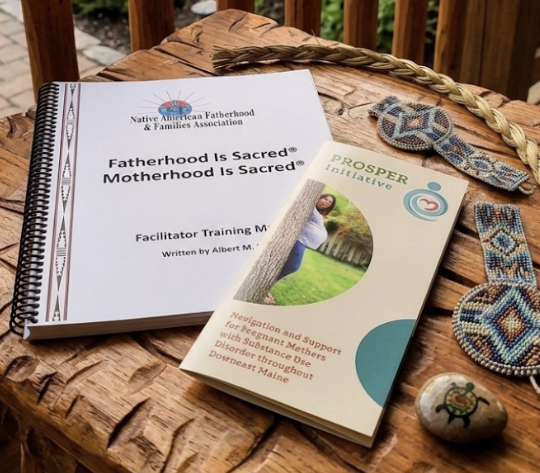
With Foundation support, PROSPER launched parenting support groups earlier this year using culturally grounded curricula for Native families – Fatherhood Is Sacred and Motherhood Is Sacred.
Developed by Albert Poole with the Native American Fatherhood and Families Association, the curricula take a strengths-based approach to parenting support. Over 12 sessions, participants reflect on self-worth, cultural identity, family resilience, and the sacred role parents and caregivers play in children’s lives. The program does not prescribe how caregivers should or should not raise their children. Instead, it reinforces how parenting with love and intention can offer purpose, strength, and the chance to heal generational trauma.
This nonjudgmental approach has resonated deeply with the people who have joined the groups, Norris said. Open to all caregivers in the community, the discussions offer participants the chance to share challenges, learn from one another, and recognize that they are not alone.
“No family is perfect,” Norris said. “Hearing other people’s experiences really normalizes the hard things we go through as parents.”
The groups have also helped participants build valuable social connections. After completing the sessions, Norris said, several participants started a book group so they could continue their conversations.
As the groups continue to grow, the team has also worked with community partners to adopt the curriculum more widely. Pleasant Point Child Welfare has approved Father Is Sacred and Motherhood Is Sacred as a parenting program for families it serves, and Indian Township School plans to offer the program to educators during an in-service training. The curricula has also been approved for continuing-education hours through the Maine Roads to Quality Professional Development Network.
Importantly, the support groups have helped navigators deepen their relationships with caregivers, who now feel more comfortable asking them for assistance. By helping families access resources while building on their cultural values – with relevant messages delivered by trusted messengers – PROSPER is bringing together a powerful combination for caregivers and children alike.
“Taking some of those worries off their shoulders gives parents a little bit of space so they can breathe and connect with their child with purpose,” Norris said. “We’re helping them become a calmer, safer, more stable presence so their child can thrive.”