
At the heart of the two-generation (2Gen) approach is a simple but powerful idea: parents are experts in what their families need to thrive. Keeping their voices at the center is integral to the approach – from shaping programs around parents’ priorities and goals to engaging them as leaders and partners, not just participants.
When intentionally and consistently put into practice, this principle strengthens outcomes in several ways. Programs that meaningfully integrate parent voice are more likely to reflect families’ real experiences, adapt to changing conditions, and improve over time. Families, in turn, are more likely to engage with programs where their perspectives are respected and reflected.
In its 2Gen work with organizations across the country, Ascend at the Aspen Institute recommends a number of best practices to help achieve these kinds of results – to find out more, read our interview with Danielle Christenson.
In Maine, several John T. Gorman Foundation partners — and the parents they work with — also have valuable insights to share. Across the state, these 2Gen leaders are working alongside parents to build programs that are making a difference for families and strengthening whole communities. We profile three of these efforts below – Community Caring Collaborative, Zero to School Starting Strong, and Moving Families Forward – highlighting how they have shaped and evolved their programs around parent voice and the lessons they are learning. (Click below to expand profiles.)
Community Caring Collaborative

For nearly 20 years, Community Caring Collaborative (CCC) has worked to strengthen partnership and collaboration among organizations serving families in Washington County. Throughout its history, the organization has actively engaged parents as partners – not only to identify the community’s most pressing challenges, but to shape the 2Gen solutions families say they need to address them.
One of the clearest examples is Family Futures Downeast, now in its 10th year of providing coordinated coaching and supports for post-secondary student parents and their children. The initiative emerged from a CCC Vision Day, where parents shared their need for support in pursuing a college education to help them secure family-sustaining careers. Designed in response, the program has continued to evolve based on parent feedback – including expanding supports for older youth, offering more flexible childcare options, and tailoring programming to reach more fathers.
To date, more than 200 parents have participated in Family Futures Downeast, impacting over 1,100 household members.
According to CCC Director Charley Martin-Berry, authentically seeking parent voice – and acting on the priorities parents identify – has been critical to supporting sustained engagement across the organization’s initiatives.
“The work has to be driven in response to the needs and aspirations of parents and children,” Martin-Berry said. “All the strategies, all the partnerships have to come from parents saying, ‘This is what we need, this is what we want, and this is what is standing in the way.’”
Family Futures Downeast alumna and parent leader Lydia Neddeau agrees. She is currently working with CCC and other partners on an initiative to help local youth access driver’s education — the costs of courses and lack of personal vehicles are barriers to many families.
“I’ve proposed numerous times that we need some sort of driver’s education program to provide the opportunity for these kids to get their licenses,” Neddeau said. “I appreciate how they really listened and are working hard to get one started.”
Creating the right conditions for parents to share this kind of honest feedback requires intention. In addition to offering multiple ways for busy parents to share their input and providing meaningful support over barriers like transportation, childcare and other expenses, CCC sends invitations through “trusted messengers” who already have deep relationships with families and actively works to remove bias and judgment when engaging parents.
Martin-Berry added that follow-through is also critical. If you ask for feedback, be prepared to act on it.
“It’s not a lip service kind of thing,” she said. “You ask for their input and their ideas and the solutions that are going to work for them – then you do your best to build what they say is going to work. When they see that feedback reflected in the programs their family will benefit from, it’s incredibly powerful.”
Zero to School Starting Strong
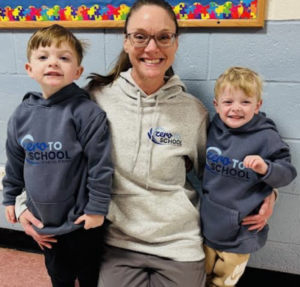
Big things can happen when parents are given the opportunity to guide and take ownership in the programs serving their families.
This is what Jessica Berry is seeing through Zero to School Starting Strong, an initiative she designed to bring early supports to children and families in Knox and Lincoln counties. Responding to a severe lack of services in the area, the initiative has created a mobile team to conduct developmental screenings for children ages 0–5 and provide a range of specialized interventions and supports for their families.
As this work unfolded, Berry’s team recognized a growing need and opportunity. On the sidelines of their children’s screenings and play groups, parents were meeting and having conversations. Seeing an unmet need, the team decided to see what would happen if the parents were given space, time, and childcare to connect as a group.
“We wondered if they would talk to each other, but that first meeting flew by because they were so open with each other,” Berry said. “Clearly, this was something they wanted and were looking for.”
Since then, the initiative has convened monthly parent groups, providing structure and resources to support peer conversations on everything from homelessness to isolation to substance use recovery. Still, the team is careful to ensure parents are setting the direction.
That balance and partnership have helped bring engagement to a new level – parents are now asking to help lead and organize the groups. As Berry seeks opportunities to support their development as leaders, the parents are already helping each other out, proposing new ideas, and spreading word of the initiative throughout the community.
Now, as the initiative completes its first year of implementation, Berry regularly receives calls from families who have been referred by their friends and neighbors – an indication that parent engagement and buy-in have helped Zero to School Starting Strong gain a foothold in the community.
“To ensure that we are providing something that families will access, parents need to be drivers of how we develop it,” she said.
Moving Families Forward

Moving Families Forward demonstrates how a 2Gen approach is strengthened when organizations respect family and youth perspectives as essential to effective practice.
This partnership between Bangor Housing and the Boys & Girls Club of Bangor provides comprehensive, integrated supports for whole families – including economic pathways for parents that incorporate savings, career development, and education, alongside youth development opportunities. Listening to the voices of both parents and young people is central to their approach, with each organization gathering feedback in its own setting and using what it learns to inform shared decisions.
“To move from involvement to engagement, you have to lead with your ears,” said Catherine Myatt, Executive Director of the Boys & Girls Club of Bangor.
Club staff rely on frequent, informal interactions – brief conversations at the door, quick text- or QR-based surveys, and check-ins during transitions – to understand what is working for families and where adjustments are needed. When parents shared that programs conflicted with their work schedules, the Club adjusted its hours. Structured leadership groups give older youth a similar opportunity to shape how activities evolve.
Bangor Housing incorporates parent voice through listening sessions, short surveys, and ongoing dialogue with residents. These conversations help clarify barriers families face and guide more responsive supports. Parent feedback recently led to the addition of free driver’s education after residents identified transportation as a persistent obstacle to work. During a meeting about the new offering, one resident recognized the idea as his own – a moment that underscored how trust builds when families see their input reflected in real decisions.
Across both organizations, parents and youth consistently emphasize that what matters most is seeing their feedback lead to tangible change. According to Liz Marsh, Director of Resident services at Bangor Housing, the approach reflects a core belief: “Families are the experts on what they need.”